
PopCap’s Plants vs. Zombies, released in 2009, was the first entry into a well-loved franchise of tower defense games featuring iconic character designs and simple, intuitive mechanics. Throughout 50 different levels and five different worlds, you play as a gardener defending their home from a zombie invasion using the only real weapon at your disposal: your green thumb.
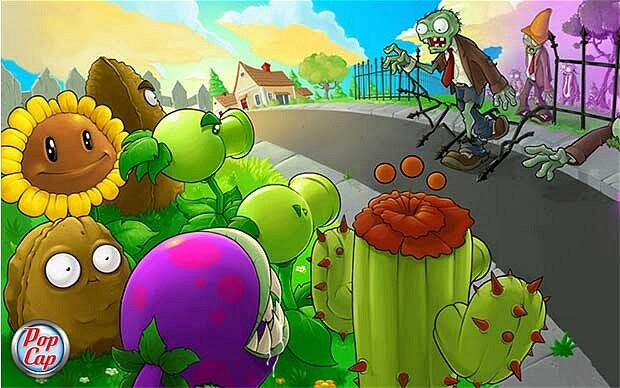
Sunflowers produce “sun”, a kind of in-game currency used to place more plants on the board. Peashooters launch pea-shaped projectiles at the zombies to whittle away their health. Walnuts act as living barriers to slow zombie’s progress towards your house. There is certainly a difficulty curve throughout the game, but the challenge it presents is never insurmountable. To this day, I still think back fondly on my experience beating the final boss of PvZ as a child. It was one of the first real games I was able to finish, and that’s an experience that sticks with you.
As an adult, however, I still find myself returning to the property every now and then. And, when I do, I always manage to dig up something new about the game that I’d never noticed before. For today’s post, I’ll be focusing on the dynamic nature of its backing soundtracks.
To start us off, take a listen to the default background music that plays during a standard daytime, front lawn level of PvZ :
You’ll likely notice first that the melody itself here is delightfully macabe, but not grim or dark whatsoever. It fully commits to its spooky premise without descending into horror—and that’s not always an easy balance to strike.
As you start to tune into the instrumental features at play, however, you’ll probably pick up on the fact that the first 30 seconds are relatively simple. A string instrument and piano duet the well-known notes of PvZ ‘s backing music…until the drums kick in and take the whole thing up a notch.
What’s worth noting here is that these musical shifts correspond directly to events occuring in-game, because they are dynamic. The first 30-seconds of the clip plays on loop during the opening section of a level before the first wave of zombies spawns and the player is placing down their first plants. The powerful drum line, then, directly singles the arrival of a threat.
At the end of a level, as the waves of zombies increase, this standard backing track is swapped out for a horde-variant:
This horde-variant builds upon all the features of the previous track with the inclusion of more instruments, such as the tamborine, gong, and cymbals. These heavy percussive elements continue to signal the intensity of the threat present to the player, gradually building up tension though a series of minor, neigh-imperceptible shifts.
And this dynamic quality is not exclusive to the daytime levels! Each world: Daytime Front Lawn, Nighttime Front Lawn, Pool, Fog, and Roof, feature this same escalating system.
I won’t be discussing all of them in detail, but for one more example, compare the normal and horde variants of the Roof Level soundtrack:
The standard version varies significantly from the Front Lawn levels in its use of “hollow” sounds, like that of the bell and the light percussive element carrying the beat with only the occasional piano interlude.
When the horde-variant kicks in, instead of relying on percussion for an ominious effect, the Roof Level soundtrack adds in a synth—the robotic nature of which perfectly foreshadows the upcoming introduction of the game’s final boss: the maniacal Dr. Zomboss and his mecha Zombot!
As the final battle commenses, the synthetic elements enter in full force. The organic instruments, such as the piano and tambourine, which have accompanied the player throughout the whole game, are still with them, fighting against the artificial sound of the enemy as it threatens to engulf them entirely. Until the very end, the music of PvZ is always parallel to the player’s own struggle.
Taking some time to sit with the soundtrack of a piece of media that had such a meaningful impact on my relationship with video games has been truly rewarding. When we’re young and impressionable, we often take for granted the characteristics that make the things we love so very special in the first place. It often isn’t until we’ve grown up a bit that we’re finally able to pinpoint what exactly it was that was so worth loving.
Not everything stands the test of time, of course, but I’d encourage you to take the time to revisit old properties every now and again. You never know what you’ll find!